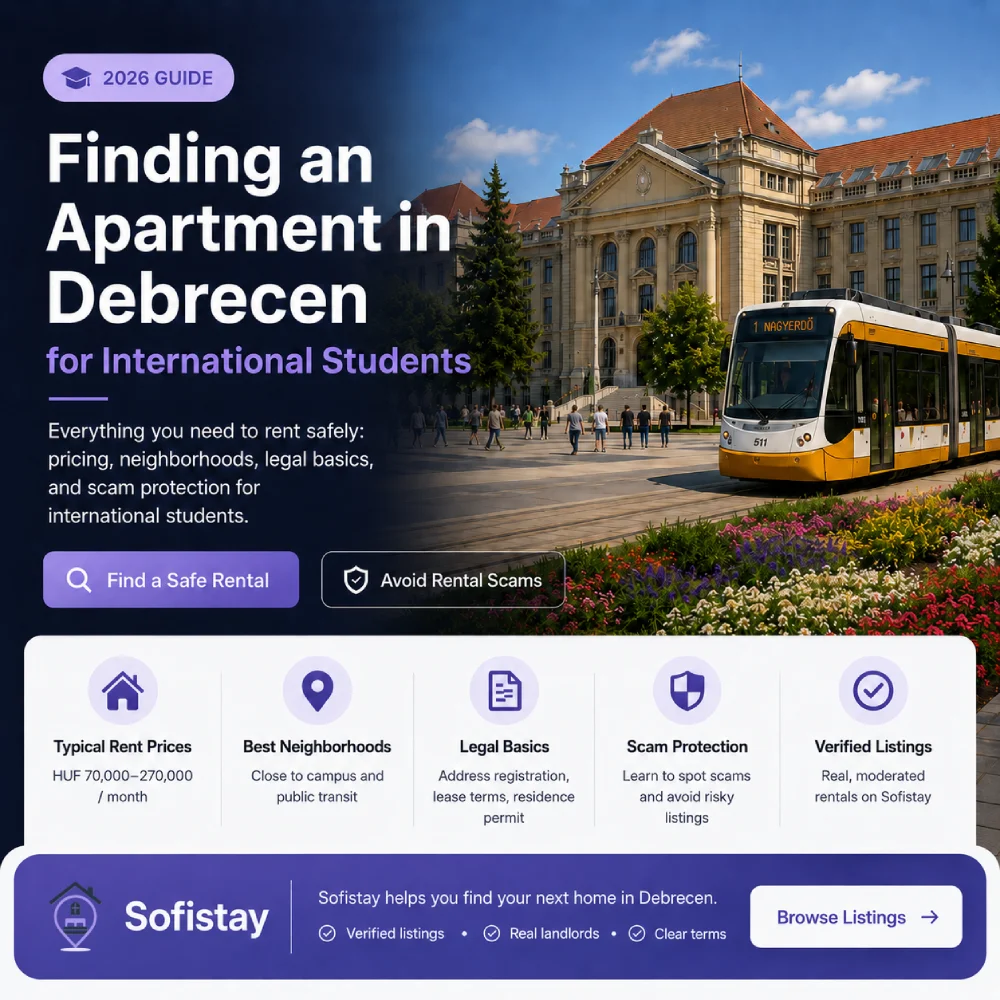
Finding Student Accommodation in Debrecen: The Complete 2026 Guide for International Students
What renting really costs, which neighborhood fits your campus, the legal essentials your residence permit depends on — and how to avoid the scams that target international students.
How international students find safe housing in Debrecen
Budget roughly 70,000–270,000 HUF per month depending on whether you rent a room, a studio, or a full apartment, plus a deposit of one to two months' rent and usually one month's rent in advance. Always insist on a written, signed lease before paying anything, never send money for a property you haven't seen in person or on a live video call, and pay only by traceable bank transfer. Choosing a dormitory or a verified listing platform over an anonymous social-media post dramatically reduces your risk of fraud.
Key facts at a glance
Debrecen is the most expensive regional university city in Hungary for renters.
A room in a shared flat costs roughly 70,000–120,000 HUF per month; a full apartment 180,000–270,000 HUF.
Hungarian law caps a rental deposit (kaució) at three months' rent; two months is the norm.
The typical move-in cost is one month's rent in advance plus a one- to two-month deposit.
Non-EU students need proof of accommodation — a dormitory certificate or a signed lease plus an accommodation reporting form — for a residence permit.
Registering your address in Hungary requires the landlord's signature — which a fraudulent landlord cannot provide.
The University of Debrecen has four main campuses: Nagyerdő, Kassai út, Ótemető, and Böszörményi út.
Tram Line 1 connects Debrecen's railway station and city center to the Nagyerdő university area.
What renting costs in Debrecen
Debrecen is home to the University of Debrecen, Hungary's oldest continuously operating university — and demand has made it the most expensive regional university city in the country for renters. Here's a realistic 2026 picture.
Type of accommodation
Typical monthly rent
Best for
Room in a shared apartment
70,000–120,000 HUF
Sharing with classmates — the most affordable option
Studio / small "garzon" flat
120,000–170,000 HUF
Living independently on a budget
One- or two-bedroom apartment
180,000–270,000 HUF
More space, couples, or small groups
As a rule of thumb, expect around 2,000–3,000 HUF per square meter per month. At a rough 2026 rate of about 390–400 HUF to the euro, a student room is roughly €180–300 a month and a full apartment around €460–680.
Budget for the move-in cost, not just the rent
The figure that surprises most students is the total amount due up front. The Hungarian norm is one month's rent in advance plus a security deposit (kaució) of one to two months' rent — so before you get the keys you may need two to three times the monthly rent in a single payment, often 500,000–600,000 HUF or more for an apartment. Plan for this before you arrive.
On top of rent, you'll usually pay utilities (rezsi) — electricity, gas, water, internet — and, in apartment buildings, a common cost (közös költség) for shared maintenance. Always confirm which of these are included in the rent.
Where to live: match your neighborhood to your campus
The University of Debrecen is spread across several campuses. The smartest housing decision you can make is to live near the one where you'll actually have classes — a 10-minute walk beats a 40-minute commute every morning.
Medicine · Science · Humanities
Nagyerdő — Main Campus & clinics
The iconic Main Building on Egyetem tér and the medical clinics sit in this green district north of the center. Beautiful and walkable, with the baths, zoo, and stadium nearby — one of the most desirable, and pricier, areas.
Central · well connected
City center (Belváros)
Lively and full of services, connected to the Nagyerdő campuses by Tram Line 1, which runs from the railway station through the center up to the university. You're never far from anything.
Informatics · Law · Engineering
Kassai út & Ótemető
If your classes are at the Kassai street campus (Kassai út 26) or the Ótemető engineering campus, renting on the east side keeps you close — and is often a bit more affordable than Nagyerdő.
Agriculture · Economics
Böszörményi út
Students at the Böszörményi street campus to the west should look for accommodation in that direction to shorten the daily commute.
Tip: get familiar with the DKV public transport network — especially Tram Line 1. A monthly student pass is inexpensive and makes living slightly farther out perfectly practical.
Dormitory or private rental?
University dormitory (kollégium)
Cheapest and simplest, and a dormitory certificate is automatically accepted as proof of accommodation for your residence permit. The catch: places are limited and fill quickly, so you may not get your first choice.
Private rental
A room, studio, or apartment gives you far more freedom over location and privacy, with much more supply. The trade-off: you find the landlord, sign the contract, and handle your own address registration — which is where scam risk enters.
The legal essentials every international student must know
Hungarian rental law is governed mainly by the Civil Code (Act V of 2013) and the Tenancy Act (Act LXXVIII of 1993). You don't need to be a lawyer — but these core rules protect both your money and your immigration status.
Contract
Always get a written contract
A verbal or chat-only deal isn't reliably enforceable. A proper lease states both parties' names and ID details, the exact address (floor and door included), rent, deposit, term, and which utilities and common costs are included — typically signed by two witnesses, or a lawyer or notary.
Deposit
The kaució is capped — and protected
By law a landlord may ask for up to three months' rent, though two months is the norm. The deposit stays legally yours, held only against unpaid bills or genuine damage, and is returned when you move out. A demand far above three months is a warning sign — and a tactic used against foreigners.
Language
The contract usually needs to be in Hungarian
For the Immigration Office the lease generally has to be in Hungarian; a bilingual contract is fine but will normally state that the Hungarian version prevails in a dispute. Never sign a document you don't understand — have it explained or translated first.
Term
Be careful with fixed-term contracts
A fixed-term lease generally cannot be terminated early without serious consequences, except for breach. Think hard before locking into a long fixed term in a city you've just arrived in.
Residence permit
Your permit depends on verifiable accommodation
Non-EU students must prove they have somewhere to live — a dormitory certificate, or a signed lease plus an accommodation reporting form the landlord personally signs. Staying longer than 30 days, you must also register your address (receiving an accommodation slip with a QR code, or an address card / lakcímkártya).
The hidden scam filter: address registration requires your landlord's cooperation and signature. A legitimate owner will provide it. A scammer — or a landlord renting "off the books" — cannot. Ask early: "Will you sign my accommodation reporting form and let me register my address here?" The answer tells you a great deal.
How to spot and avoid rental scams
International students are a favorite target for rental fraud across Europe, and Hungary is no exception. Scammers know newcomers are far from home, unfamiliar with local norms, and under time pressure before the semester starts. The schemes are predictable once you know them.
The classic fake-listing scam: an attractive apartment appears at a suspiciously good price, often with beautiful photos. When you inquire, the "landlord" says they're abroad or otherwise unable to show it, but it's in high demand. They ask for a deposit or first month's rent up front — often to a foreign account, or via wire transfer, gift cards, or cryptocurrency. The moment the money lands, they vanish. There was never an apartment, or the photos were stolen from a genuine listing.
Red flags to watch for
The price is too good to be true. Rents well below the figures above are bait. If it seems unreal, it usually is.
You can't view the property. Any refusal to let you see it — in person, or on a live video call where they walk the actual rooms — is serious. Pre-recorded clips prove nothing.
Pressure to pay before viewing or signing. Urgency is a manipulation tactic. No real landlord needs money within the hour.
Untraceable payment. Western Union, MoneyGram, gift cards, crypto — favored because the money can't be recovered. Insist on a traceable bank transfer to a Hungarian account in the landlord's name; if the name doesn't match, stop.
The same photos appear in multiple ads. A quick reverse-image search can expose a copied listing.
No proper contract, or generic, unverifiable "ownership" documents. Fake paperwork can look professional and still be worthless.
The single most protective habit: never pay anything for a property you haven't seen and a contract you haven't signed. Deposit and rent are normally due when you sign the lease — not before.
A safe, step-by-step process
Start early. The market peaks right after admission decisions and before each semester. Begin weeks ahead, not days.
Shortlist from trustworthy sources. Prefer the university housing office, dormitory options, and verified or moderated platforms over anonymous social-media groups, where fake posts are most common.
View before you commit. Visit in person, or insist on a live video walkthrough of the actual apartment if you're still abroad — rooms on request, not a polished highlight reel.
Verify who you're dealing with. Confirm the landlord's identity and their right to rent. A genuine owner won't object to reasonable questions.
Read the contract carefully. Get a bilingual version or have it translated. Make sure rent, deposit, term, utilities, and common costs are all written down.
Pay only by traceable bank transfer, to an account in the landlord's name, and only after signing. Keep records of every payment.
Confirm address registration up front. Make sure the landlord will sign your accommodation reporting form so you can register your address and keep your residence permit valid.
Why verified listings matter
Every safeguard here points to the same problem: when you're new to a city and a country, you can't easily tell a real landlord from a fake one. That uncertainty is exactly what fraudsters exploit.
A moderated, verified-listing platform removes much of that burden. When listings and the people behind them are reviewed before they go live, the most common scams — stolen photos, ghost apartments, fake landlords who could never sign your residence-permit paperwork — are filtered out before they reach you. You still do your own viewing and read your own contract, but you start from a far safer pool than an open social-media feed.
That's the principle SofiStay was built on
It grew out of real hosting experience — founder Zsófi hosts on Airbnb and knows the renter's side firsthand — combined with a professional background in security and verification. The aim is simple: a place for international students in Debrecen to find accommodation where the listings are checked, the landlords are real, and the paperwork you need for your residence permit is something an honest host will gladly provide.
Expect roughly 70,000–120,000 HUF per month for a room in a shared flat, 120,000–170,000 HUF for a studio, and 180,000–270,000 HUF for a full apartment, plus utilities. Debrecen is currently the most expensive regional university city in Hungary for renters.
Kaució is the Hungarian word for the security deposit — a sum (legally up to three months' rent, usually two) that the landlord holds against unpaid bills or damage and must return when you move out if you've met your obligations.
One to two months' rent is normal; three months is the legal maximum. A landlord demanding significantly more than three months is a red flag, and a tactic sometimes used specifically against foreign tenants.
Typically one month's rent in advance plus a one- to two-month deposit — so two to three months' rent in a single payment, often 500,000–600,000 HUF or more for an apartment. Budget for this before you arrive.
You can begin the process, but never pay for a place you haven't seen. Insist on a live video walkthrough of the actual apartment and a signed contract, and only transfer money — by traceable bank transfer — once the lease is signed.
For the Immigration Office, the lease generally needs to be in Hungarian. A bilingual Hungarian–English contract is fine and recommended, but it will usually state that the Hungarian version prevails in any dispute.
Non-EU students need either a dormitory certificate or a signed lease plus an accommodation reporting form signed by the landlord, and must register their address. A landlord who won't sign these cannot legally host your registration — a major reason to choose a verified host.
Dormitories are cheaper and simplest for paperwork but limited and fill quickly. Private rentals offer more choice and freedom but require you to find a trustworthy landlord and handle the contract and registration yourself.
Debrecen has an efficient tram and bus network (DKV). Tram Line 1 connects the railway station and city center to the Nagyerdő campuses, so living centrally or along that line makes commuting easy. A monthly student pass is inexpensive.
Never send money for a property you haven't seen and a contract you haven't signed, and always pay by traceable bank transfer to an account in the landlord's name. Choosing a verified or moderated source over anonymous posts removes most of the risk before you start.
Adatvédelem
Süti beállítások
Statisztika csak engedéllyel
Sofistay.com a weboldal működéséhez szükséges sütiket használ,
megjegyzi az Ön választását, és opcionális látogatottsági mérést indít csak akkor,
ha ehhez hozzájárul.
Szükséges működés
A weboldal alapvető működéséhez és az adatvédelmi választás megjegyzéséhez szükséges.
Ez nem kapcsolható ki.
Mindig aktív
Látogatottsági mérés
Segít megérteni, mely oldalakat nézik meg a látogatók és milyen eszközről érkeznek.
Csak az Ön engedélyével működik.